




If you step into the boardroom of a large manufacturer that distributes consumer goods or a retail chain, you’ll notice something strange. On one side of the warehouse, the shelves are empty of their fastest-moving SKUs, while on the other side, the slow-moving stock accumulates, ages, and eventually expires. The finance team is well aware of the working capital problem. The operations team is also very aware that the inventory is not available when required. They are unable to connect the dots between the reasons for both these challenges. They have no idea that the root cause of both problems is not the supply chain. Something else is at play. Something that sits between the supply chain and its impact on the business.
For top tech and supply chain bosses, this is a wake-up call and a chance to make things right. The money tied up in extra stock, wasted because it’s damaged or expired, or lost when customers go elsewhere due to stockouts is exactly the issue that smart warehouse management can fix – but only if they have the right tools in place.
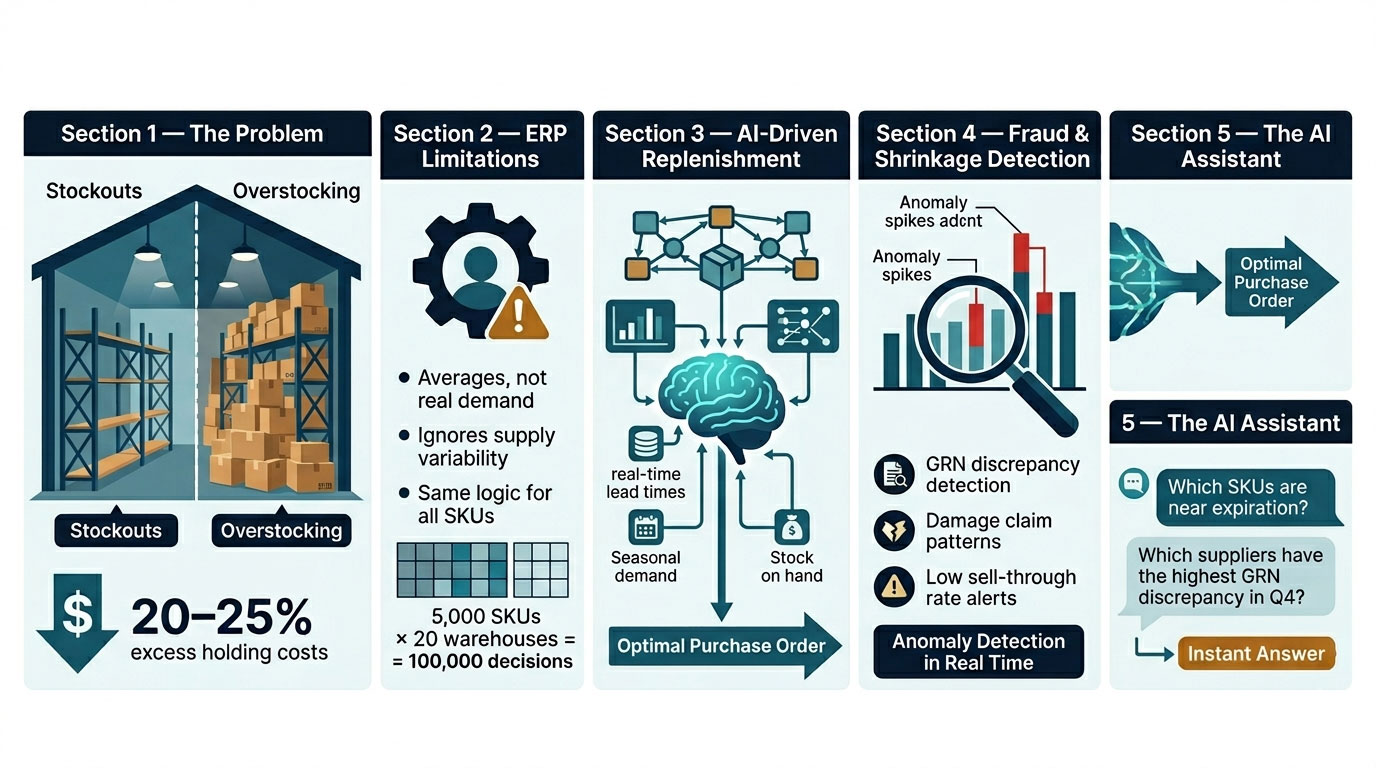
The costs for holding inventory are 20-25% more than what’s typical around the world. But this difference isn’t because of any fundamental issues – it’s really about the technology and information used.
Why ERP-Based Replenishment Has Hit a Ceiling
Most companies maintain their inventory through their Enterprise Resource Planning (ERP) system. They have a reorder point (ROP) and lead time defined for every item in their ERP system. When the inventory level of an item falls below the ROP, the ERP system auto-releases a Purchase Order (PO). Sounds very systematic, doesn’t it? But there are always shortcomings to any fixed logic system. The ERP system works on averages and not on the actual demand at the point of consumption. It does not take into consideration the variability of supply from vendors. And neither does it take into consideration seasonal demand fluctuations. The most critical thing is that the same logic is applicable to all SKUs. So a fast-moving perishable item and a slow-moving non-essential item both follow the same reorder logic.
At scale this all falls apart. An enterprise managing 5,000 SKUs across 20 warehouses is making inventory replenishment decisions for 100,000 SKUs at any given time. There is no ERP rule engine, static or dynamic, that can manage these decisions and do so in a way that is optimally aligned with business goals. Rather, what you are left with is a product assortment where a handful of items are always overstocked and a handful are always understocked – not because the business has chosen to hold inventory in these places, but rather because the inventory system is unable to manage real-time inventory needs.
What AI-Driven Replenishment Actually Changes
AI-based WMSs are different from traditional types of WMS. An ERP system with a traditional type of WMS based on static rules will automatically generate a purchase order based on the reorder point established for the product. On the other hand, an ERP with an AI-enabled WMS uses dynamic learning algorithms to ingest data while generating a purchase order based on the real-time consumption rates of each product or SKU, the number of days of stock on hand, vendor lead times, future forecasted demand, and other data related to the supply chain of the product. The AI-based algorithm is used to analyze and understand the pattern of demand of each product and then, based on its rules of the supply chain, determines the action required for purchasing more stock to avoid stock-out situations. These rules and determinations are not based on historical demands or static rules but on real-time supply chain events and activity.
An inventory reporting system will tell you when your inventory levels are low and what you may need to order, along with suggested order quantities for each of your suppliers. An AI-based inventory replenishment system does all of that and more. In addition to demand history and supply chain volatility, it also takes into account real-time data to determine optimal inventory levels to avoid stockouts and then alerts purchasing with sufficient details to choose from a variety of ordering alternatives. There’s a big difference between reporting and enabling.
The Inventory Fraud Problem Nobody Is Measuring
While we talk about working capital leakage in warehouses, there is a less visible but equally important component of inventory shrinkage which is being lost in the noise. A single entry of a damage claim being overstated or a GRN entry being altered may not seem like much at the time of entry. However, an associate having a pattern of high damage claims, a supplier having a pattern of GRNs which are different from the purchase order or a set of pincode areas having high rates of rejection are patterns which are only visible when the data is analyzed over time and across entities.
A WMS that uses artificial intelligence & anomaly detection to track receipts, shipments, inventory adjustments, damaged receipts and inventory audits in real time and over time to build up statistical normal behaviour by warehouse, SKU category and user role and alert you immediately when something unusual is detected so that small issues are resolved before they become large losses of money. In addition to anomaly detection, the system also has low sell-through rate (STR) reporting, inventory deficit reporting and wastage tracking to give supply chain leaders an absolutely forensic level of insight into where exactly losses of working capital are occurring and what the root causes of those losses are.
The Full WMS Stack: Inbound, Outbound, and Integration
Working capital optimisation is a key benefit of having an intelligent Warehouse Management System (WMS) and is applicable to all warehouse operations. Inbound, for example, will involve the use of a set of rules to automatically determine the timing of dock appointments, whether quality checks need to be undertaken, where inventory will be stored, whether a receipt will be automated and what documentation may be required. Putaway rules may include velocity, size, bin availability and other considerations to direct high-velocity items to pick faces and fragile or restricted items to alternate storage locations. In putaway, staff are guided to the required bins and locations using a barcode scanner on a mobile device.
Dynamic picklists can be created for single and multi-order picking on the outbound side and used with guided picking on handheld devices to give staff the most efficient pick path, reducing walking distance and reducing pick errors. Wave picking allows for batching of orders to deal with peak volumes. On the inbound side, FIFO and FEFO controls can be enforced operationally as part of inventory rotation processes, and continuous cycle counting can be run without any interruption to warehouse operations.
For enterprise technology teams, the integration architecture matters as much as the capabilities themselves. A WMS that can integrate with any SAP, ERP or eCommerce/OMS/TMS system using standard APIs becomes extremely valuable. A system that can also be integrated with IoT devices using Excel-based integrations, making it easier to fit into the existing tech stacks. For enterprise customers, the WMS needs to be deployed as a plugin module, and features like auto-replenishment or anomaly detection can be switched on and off as required without having to replace the legacy ERP system.
 The Integrated AI Assistant: Turning Warehouse Data Into Decisions
Using an integrated AI assistant, the warehouse manager & supply chain leader can ask questions regarding the status of their warehouse inventory in a more natural and human way than they would with traditional reporting interfaces. For example, the warehouse manager may ask the following:
- “Which SKUs are near expiration across all locations?”
- “Which suppliers have the highest GRN discrepancy rate in Q4?”
And get immediate answers without having to:
- Generate reports, share with stakeholders or log a request with business intelligence.
- Collaborate with Business Intelligence to build the reports required to answer their ad-hoc questions
- Spend a lot of time setting parameters and fields to build reports.
In a fast-moving warehouse environment, the period between asking and receiving an answer can be critical. Preventing an expiry loss or avoiding a stock-out can depend on it.
The Bottom Line
Industries has built a huge amount of infrastructure in the last 10 years to meet its supply chain needs. The margin erosion is happening in the application layer of our systems. Where we have inventory decisions being made based on static rules, obsolete data and manual interventions for dealing with issues like overstocking, stockouts, obsolete inventory and inventory shrinkages. An intelligent WMS can address all these issues and is available technology that can be implemented in a matter of a few months. The entire industry of manufacturing, FMCG, pharma and retail can only wonder as to how much working capital can be saved by deploying an intelligent WMS – a margin that will be lost to competition while they deliberate the pros and cons of such a decision.
About the Author: Vaibhav Mishra is Director of Technology at Libera, a supply chain technology platform powered by ElasticRun. Libera’s Warehouse Management System is part of a battle-tested technology stack that has powered India’s largest logistics and fulfilment networks and is now available as a global SaaS platform.