


AI growth, cloud demand, and new infrastructure investments are set to double U.S. data center capacity despite power and community challenges
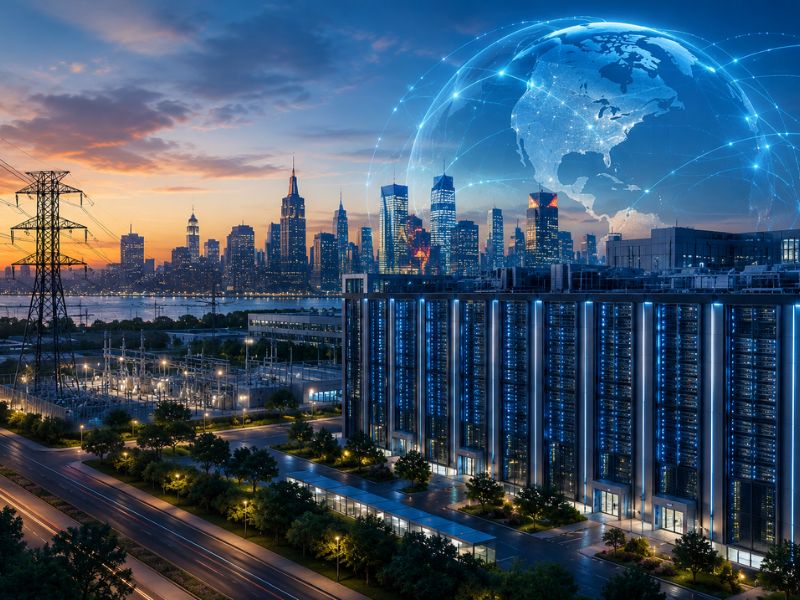
New York, United States, 31 July 2026 – The United States is entering a new phase of digital infrastructure growth as demand for artificial intelligence, cloud computing, and high-performance data processing continues to rise. Industry analysts predict that the country’s data center capacity will double over the next three years, highlighting how critical these facilities have become to the modern economy. While concerns around electricity demand, land use, and local communities remain, companies continue to invest heavily to meet the world’s growing appetite for digital services.
Data centers are the backbone of today’s digital world. Their powerful cloud platforms store business information, support streaming services, enable online banking, and run AI applications that millions of people use every day. As AI technologies become more advanced, they require significantly more computing power, creating an urgent need for larger and more efficient data centers.
One of the biggest drivers behind this expansion is the rapid rise of hyperscale cloud providers. These companies operate massive facilities capable of handling enormous workloads for businesses, governments, and consumers. Their investments are expected to account for much of the new capacity being built across the United States. Nearly half of the world’s planned large-scale data centers are currently located in the U.S., with dozens of companies actively expanding their infrastructure.
Alongside hyperscalers, a new generation of cloud providers known as neoclouds is emerging as an important force in the market. Unlike traditional cloud providers that offer a wide range of services, neoclouds focus on delivering specialized computing resources for artificial intelligence workloads. They provide businesses with fast access to advanced graphics processing units, allowing organizations to develop and deploy AI applications without building their own expensive infrastructure. Their flexibility and speed are creating new opportunities for technology partners, managed service providers, and solution integrators.
The growing partnership between hyperscalers and neocloud providers is also changing the industry. Rather than competing directly, many large cloud companies are working with specialized providers to meet increasing AI demand. This collaborative approach enables faster deployment of computing resources while expanding capacity across multiple regions.
Despite this remarkable growth, the industry faces several significant challenges. One of the largest is access to reliable electricity. AI-driven data centers consume enormous amounts of power, placing increasing pressure on local electrical grids. Utilities, developers, and infrastructure providers must work together to expand energy capacity while supporting sustainability goals. Power availability has become one of the most important factors influencing where new facilities can be built.
Communities are also paying closer attention to new developments. Residents in some areas have expressed concerns about noise, water usage, environmental impact, and increased electricity demand. These concerns have made permitting more complex and, in some cases, slowed construction timelines. Industry experts believe that stronger engagement with local communities and improved planning will be essential for maintaining long-term growth.
Even with these obstacles, demand continues to outpace supply. Vacancy rates remain extremely low across major data center markets as businesses race to secure computing capacity for AI applications, cloud services, and digital transformation initiatives. The shortage of available space is encouraging developers to accelerate construction and invest in new facilities across the country.
The expansion of U.S. data centers is expected to support innovation across multiple industries, including healthcare, finance, manufacturing, education, and retail. Organizations embracing AI will require secure, scalable, and energy-efficient infrastructure capable of supporting increasingly complex workloads.
As artificial intelligence continues to reshape industries and digital services become even more integrated into daily life, data centers will remain at the heart of technological progress. The coming years are expected to bring unprecedented investment in infrastructure, creating new opportunities for cloud providers, technology partners, enterprises, and businesses seeking to build the next generation of AI-powered solutions.