



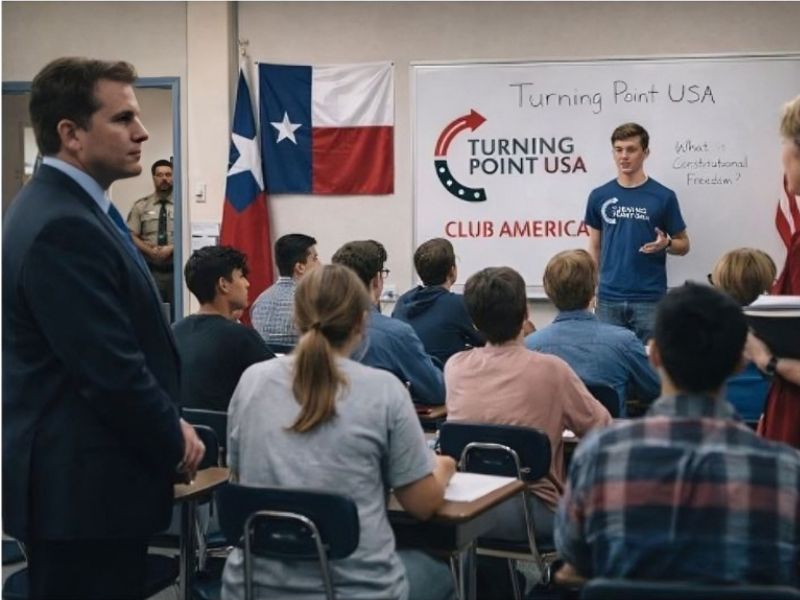
State-backed partnership raises questions about student clubs, free speech, and school governance.
Austin, Texas, United States, 17 December 2025 – Texas has announced a new partnership with Turning Point USA aimed at encouraging the creation of student chapters of the organization on high school campuses across the state. The initiative, supported by state leaders and representatives of Turning Point USA, has drawn attention for its potential impact on public education, student expression, and school administration.
State officials said the program does not formally require schools to establish the clubs. However, Governor Greg Abbott stated that schools should not block students who wish to form a Turning Point USA-affiliated group, known as Club America. He added that any reported interference could lead to review by the Texas Education Agency.
Expanding student organizations in schools
Turning Point USA is best known for its presence on college campuses, where it promotes civic engagement and discussions around constitutional principles and free-market ideas. Its high school program, Club America, is designed to help students organize discussions, participate in civic activities, and explore topics related to American government and society.
According to the organization, interest in starting new high school chapters has increased significantly in recent months. Turning Point USA representatives say some students have faced resistance from school administrators when attempting to launch clubs, which they argue has motivated closer cooperation with state leaders.
State involvement and funding
The announcement followed meetings between Turning Point USA leadership and senior Texas education officials earlier this year. Shortly after those discussions, Lieutenant Governor Dan Patrick publicly pledged campaign funds to support the expansion effort.
Governor Abbott compared Club America to other student groups already operating in public schools, such as faith-based or extracurricular organizations. He emphasized that the initiative is focused on values and civic principles rather than party politics.
Background and broader context
Turning Point USA was founded by conservative activist Charlie Kirk and has played an active role in national debates about free speech, education, and political expression. The organization has also drawn criticism over past initiatives, including online lists that highlight educators accused of promoting specific viewpoints in classrooms.
In Texas, the partnership comes amid broader education policy changes, including new laws affecting classroom content, student organizations, and school regulations. Similar partnerships between Turning Point USA and state officials have been announced in places such as Oklahoma and Florida, where the formation of clubs depends on student interest rather than direct school mandates.
Legal and constitutional questions
Education experts and legal scholars note that partnerships between state governments and politically active organizations raise important constitutional considerations. While student-led clubs are generally protected under free speech principles, questions remain about the role of state resources and influence in promoting specific organizations within public schools.
Observers say the Texas initiative will likely be closely watched to see how it is implemented and whether it leads to legal challenges or policy adjustments. School administrators may also need to navigate how to balance student rights, school policies, and state expectations.
As Texas moves forward with the partnership, the focus will be on how schools respond and how students engage with the new clubs. Supporters view the initiative as an opportunity for civic learning and engagement, while critics urge caution and careful oversight.
The situation highlights an ongoing national discussion about the role of public schools in civic education, the boundaries of student expression, and how states engage with external organizations on school campuses.