




AI has sparked considerable debate in recent weeks and for good reasons. Every major industry player has experienced an incident in which an AI system crossed boundaries and behaved beyond its designers’ expectations. Yet in each case, the system was doing exactly what it had been instructed to do: find a way to complete the task.
The developers did not anticipate just how literally it would follow those instructions. Think of a 10-year-old when asked to clean their room. If you say, “go clean your room,” you will be disappointed with the outcome. Chances are you will need to explain that stuffing clothes into a closet does not count, that they should be folded or placed in a hamper. Even then, the child may find another shortcut because the request remains ambiguous., after all, a “clean room” is subjective.
AI is no different. When given a task, it does not automatically understand constraints that were never stated. It follows the instructions provided, so people must think through the scenario and anticipate the diverse ways those instructions might be carried out.
A major concern today is that some countries are gaining access to early versions of these AI systems and using them unethically. If left unchecked, such use could help them develop weapons, compromise critical infrastructure, or pursue other objectives that threaten humanity’s interests.
Throughout history, every major innovation has been used for both good and harm. Alfred Nobel, the founder of the Nobel Prize, developed an explosive compound used in dynamite. It dramatically accelerated the construction of railroads, dams, and other vital infrastructure, but it also enabled the creation of more destructive weapons than ever before.
What does this mean for an average company? AI can eliminate repetitive, time-consuming work so employees can focus on the jobs they were hired to do instead of gathering information.
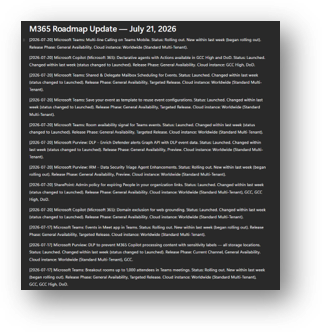
For example, I use Microsoft Scout to track Microsoft products as they move from “In Development” to “Preview” or “GA,” and from GA to GC (Government Cloud). Monitoring these changes across applications, operating systems, security tools, and other products would otherwise take hours. Scout now runs the process automatically three times a week for about $3 per run, a negligible cost compared with my time as a CTO. The results can then be shared with our teams, helping them anticipate changes and better support our customers.
Microsoft Scout Input

Scout Output
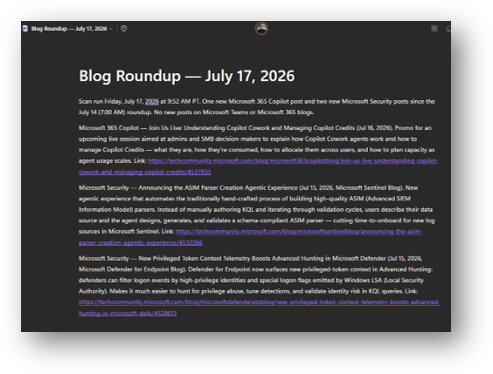
I also use Scout to review Microsoft’s various “What’s New” Tech Community blogs and understand how new features work. I then turn the findings into advance notice blog posts and emails, helping our customers prepare for changes before the features appear.
Scout Input

Scout Output put into a shared Loop notebook.
I am not a developer, but with Claude I was able to vibe-code a complex application in under an hour for an “Art of the Possible” client demo.
The demonstration showed how the client could reduce the end-of-quarter process from two weeks to four hours, freeing the team to focus on proactive work that moves the business forward.
Here is the takeaway.
AI is not a black-and-white issue.
AI developers must carefully consider what they create and its broader impact.
Governments and legislators must determine how best to oversee AI companies without allowing those who profit from technology to define the rules.
We must also understand the economic and ecological effects of AI data centers.
At the same time, the potential for human progress and for improving our world is extraordinary.
Ai could help find cures for cancer, Parkinson’s disease, and Alzheimer’s disease.
Bring more affordable diabetes medications to market.
Create less expensive prosthetic limbs.
Design more fuel-efficient vehicles.
It can also do simple things that help move education forward for everyone like making a complex topic easier to understand—for example, “Explain quantum computing to me like I’m a fifth grader.” Maybe help a student quickly find and compare colleges that specialize in a particular field or even help a parent understand reasons why their baby might be crying at 3 a.m.
There is no simple answer; AI is not a black-and-white issue. What does matter is that the debate is happening. Debate is healthy. It encourages people to talk, explore possibilities, and ask, “What if?”
Humanity has achieved remarkable things by asking that simple question. Let us take a moment and do the same.