



Every conversation about digital transformation and enterprise AI begins with compute. Organizations race to secure the latest high-density accelerators, expand power envelopes, and deploy specialized clusters to shorten training runs and speed inference. These components represent significant capital investments and face persistent supply constraints. Yet for enterprise leaders planning long-term infrastructure strategy across hybrid and hyperscale cloud environments, raw silicon is only the most visible variable.
The systemic challenge quietly threatening cloud scalability, balance sheets, and sustainability commitments lie in the physical hardware lifecycle underneath.
While software can be provisioned in seconds, the physical layers enabling modern data centers; racks, motherboards, memory modules, specialized power delivery units, and cooling distribution networks, remain tethered to an extraction-heavy, linear lifecycle. As compute density accelerates, this traditional “extract-make-dispose” paradigm creates severe supply chain, regulatory, and capital risks. Sustainable enterprise performance now requires shifting from rapid component obsolescence toward hardware lifecycle resilience and circular ecosystems.
The Hidden Weight of Embodied Carbon and Critical Materials
Discussions around data center sustainability historically focus on operational metrics, primarily Power Usage Effectiveness (PUE) and the transition to renewable power contracts. While operational energy demand is surging; projected by the International Energy Agency to more than double globally by 2030, it obscures a critical reality: Scope 3 embodied carbon.
The manufacturing phase alone accounts for 40% to 50% of a rack server’s total lifetime carbon footprint. Before a server draws its first kilowatt-hour of power on a data center floor, vast volumes of energy, water, and scarce minerals have already been consumed. Modern high-density compute relies on heavily concentrated supply chains for critical raw materials (CRMs) such as copper, high-grade silicon, gallium, and rare earth elements. More than 70% of material sourcing and advanced chip fabrication remains concentrated in a small number of geographic regions, exposing operators to geopolitical shocks and volatile procurement cycles.
When organizations operate on rigid, calendar-driven hardware refresh cadences, they discard significant embedded utility. Decommissioning enterprise-grade servers simply because they have reached a 3-to-5-year depreciation milestone; or because an AI-driven refresh cycle demands newer silicon every 12 to 18 months, creates an artificial “waste cliff”. Functional enterprise hardware capable of a viable 8-to-10-year operational lifespan is pushed prematurely into scrap streams, accelerating the global e-waste crisis and stranding enormous balance-sheet value.
The Operational Bottlenecks: Visibility and Legacy Protocols
If extending asset life offers obvious capital and environmental benefits, why does the data center ecosystem struggle to retain value? Two deep operational frictions consistently impede hardware reuse at scale:
- The Infrastructure Visibility Gap: Enterprise data centers and colocation facilities often lack unified, verifiable lifecycle asset registries. Without standardized telemetry regarding operational thermal stress, component degradation, firmware compatibility, and repair history, secondary markets cannot accurately assess residual asset reliability. As a result, decommissioned hardware is treated as a liability to clear off the books rather than an asset with graded commercial value.
- Outdated Sanitisation and Security Mandates: Corporate risk policies frequently require the physical destruction: mechanical shredding or degaussing, of storage devices and system boards upon decommissioning. While data privacy and IP security are non-negotiable, defaulting to physical destruction renders high-value hardware unusable. Industry-standard certified cryptographic erasure and software-defined data sanitisation protocols can eliminate sensitive data with complete compliance, yet legacy compliance playbooks continue to sacrifice millions of functional components annually.
Redefining the Data Center as a Cascaded System
Solving this friction requires rethinking server lifecycles as a continuous, graded performance cascade rather than a binary on/off state.
Not every enterprise workload demands cutting-edge semiconductor nodes. While foundational model training and high-frequency inference demand top-tier GPUs and ultra-low-latency interconnects, standard business-critical compute, web tier applications, containerized microservices, development clusters, and long-tail storage do not.
Fig1. Workload Tiers & Cascaded Architecture
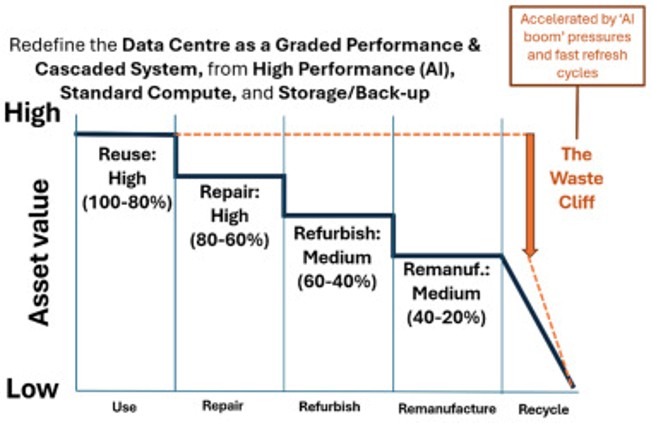
In a cascaded architecture, hardware is stepped down through operational tiers:
- Tier 1: High-density, cutting-edge accelerators handle intensive AI modelling and high-throughput pipelines.
- Tier 2: Decommissioned Tier 1 infrastructure is disaggregated. Stable memory, storage controllers, and general CPUs are redeployed into enterprise application hosting, batch-processing workflows, or non-critical staging clusters.
- Tier 3: Older equipment is adapted for cold-data archiving, backup workloads, or transferred into secondary enterprise markets and educational institutions where compute requirements are modest.
By implementing internal cascading tiers and harvesting functional components (power supply units, DRAM, heat sinks, and chassis), large-scale operators preserve capital while maintaining high system availability.
Architecture Enablers: Modularity, DPPs, and Shared Services
Transforming hardware lifecycles from an ad-hoc recovery effort into a predictable operational discipline depends on three architectural pillars:
- Modularity and Open Standards: Monolithic, proprietary server enclosures create severe lock-in and complicate mid-life upgrades. Embracing open hardware standards; such as specifications championed by the Open Compute Project (OCP), allows organizations to swap modular compute cards, storage sleds, or cooling blocks without redesigning rack infrastructure or replacing power distribution backbones.
- Digital Product Passports (DPPs): The adoption of digital passports provides machine-readable component provenance, tracking material composition, manufacturing origin, and operating hours. This transparency will soon be reinforced by global regulations, including the European Union’s Ecodesign for Sustainable Products Regulation (ESPR). Standardized passports simplify component authentication, verify remaining operational life, and unlock enterprise trust in refurbished components.
- Service-Based Consumption (Hardware-as-a-Service): Capital expenditure models naturally drive rapid write-offs. As infrastructure providers transition to service-based procurement models, original equipment manufacturers and cloud ecosystem partners retain asset ownership. This economic alignment financially incentivizes manufacturers to design for repairability, durability, and maximum residual value, since asset longevity directly improves provider margins.
The New Benchmark for Infrastructure Leadership
Enterprise leaders are expanding how they measure total cost of ownership (TCO). Just as software architectures shifted from monolithic mainframes to resilient, distributed systems, physical infrastructure strategy must evolve from disposable appliances to regenerative hardware ecosystems.
Organizations that navigate this shift will not only meet hardening regulatory scrutiny and Scope 3 reduction goals; they will also build resilient supply chains insulated from component shortages and volatile commodity pricing. True cloud resilience is not achieved merely by adding more compute racks; it requires an architecture that extracts maximum value from every watt of energy, every transistor of silicon, and every ounce of critical raw material deployed.
Find the full article by Diego Bermudez, PhD from the DICE network in here.