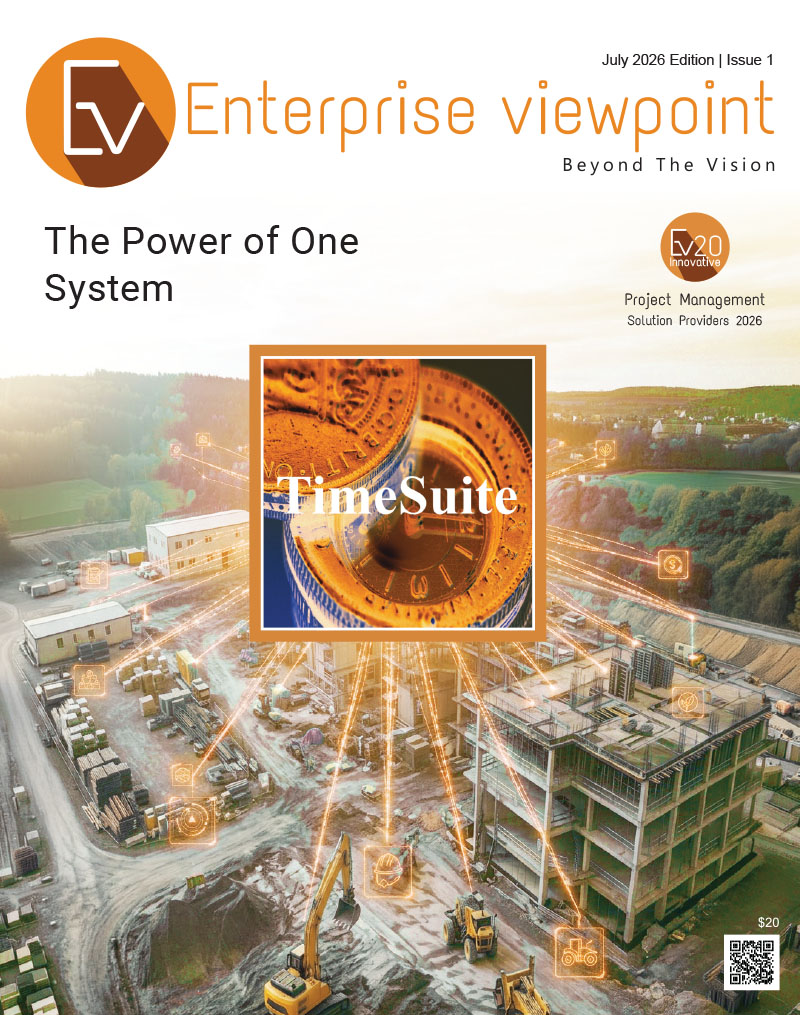




On most construction projects, information rarely travels in a straight line. An estimate is created in one application. Project managers track progress in another. Financial teams rely on separate accounting software. Documents are stored elsewhere. Schedules live in their own environment. Every update requires movement, duplication, verification, and reconciliation. By the time critical information reaches decision-makers, valuable time has already been lost.
For decades, contractors have accepted this fragmented reality as simply the way business works. But, Eric Malouff, CEO of TimeSuite, never did.
Growing up in a construction family, with a father who was a civil contractor, Malouff witnessed firsthand the challenges of managing projects, finances, and operations. Later, after studying both accounting and computer information systems, working as a programmer, and eventually founding a CPA firm specializing in construction companies, he gained a unique perspective on the industry’s operational challenges. What he repeatedly observed was not a shortage of software. It was a shortage of connected software.
Construction companies were investing in multiple systems, yet struggling to obtain a clear, real-time picture of their businesses. The more software they implemented, the more disconnected their information often became. That realization led to the creation of TimeSuite more than three decades ago—a company built on the belief that construction businesses should not have to stitch together multiple systems to manage their operations effectively. “We believed there was a better way to provide a complete picture of what was happening across an organization,” says Eric Malouff, Founder of TimeSuite.
Today, TimeSuite stands as a comprehensive construction management platform that unifies accounting, estimating, project management, scheduling, document control, communications, and workforce management within a single environment.
Built From Construction Experience
Unlike many software companies that entered the construction market from a purely technology perspective, TimeSuite was born from a deep understanding of how construction businesses operate. Malouff’s career combined three disciplines that rarely intersect at such depth: construction operations, accounting, and software development. His experience in public accounting provided insight into the financial side of construction management. His background in programming revealed the possibilities of technology. His upbringing in construction supplied practical knowledge of how projects are executed in the field. This combination shaped TimeSuite’s philosophy from the beginning.
Rather than focusing on one department or one stage of a project lifecycle, the company sought to create a system that reflected how construction businesses truly function—as interconnected organizations where every decision affects another area of the business. That vision remains central to TimeSuite today.
Eliminating the Fragmentation Problem
One of the biggest challenges facing contractors is the fragmentation of information. Most software providers excel in one area. Some specialize in project management. Others focus on accounting. Some provide estimating tools, while others concentrate on scheduling or document management.
The result is often a patchwork of systems that must be integrated, synchronized, and maintained. TimeSuite took a different approach. The company developed a platform designed to manage the entire construction lifecycle within a single system. From estimating and on-screen takeoff to project management, scheduling, document control, accounting, forecasting, cost management, and reporting, everything operates from one centralized environment. “No one really does everything,” Malouff explains. “A lot of competitors try, but we have the foundation that makes it work all the way through.”
This approach eliminates many of the inefficiencies that arise when organizations rely on multiple disconnected applications. Instead of moving information from one system to another, users access a common source of truth that supports every department and every stage of a project.
Moreover, a defining characteristic of TimeSuite is its commitment to a relational architecture. With a relational architecture, data does not travel. Data is centralized in a single system. No modules, no multiple systems, no integration. Integration is an obsolete concept in a relational environment. While the “relational” term may sound technical, its business impact is straightforward: information exists once and is available everywhere it is needed. Rather than creating multiple copies of the same information across different modules or databases, TimeSuite maintains centralized records that are immediately accessible throughout the platform. This approach eliminates duplication, reduces errors, and ensures consistency across operations. As information is entered into the system, it becomes available in real time to authorized users across the organization.
For project managers, executives, accountants, and field personnel, this creates unprecedented visibility into project and business performance. “Data goes into the system and it’s immediately accessible. That’s as real-time as real-time can possibly be,” says Malouff.
The benefits extend far beyond efficiency. Better information leads to better decisions, allowing organizations to identify issues earlier, respond faster, and maintain greater control over project outcomes.
Giving Project Managers the Tools to Succeed
Construction projects succeed or fail based on the quality of decisions made every day. TimeSuite is designed to support those decisions with accurate, timely information. The platform provides project managers with detailed budget-versus-actual analysis, committed cost tracking, forecasting capabilities, and comprehensive cost control tools. These capabilities help teams understand where projects stand financially and operationally at any given moment.
Communication and Workflow Without Barriers
Modern construction projects generate an enormous volume of communication. Emails, text messages, approvals, documents, images, daily logs, submittals, and change requests must all be tracked and managed efficiently. TimeSuite merges these functions directly into its platform.
The system incorporates communication tools that connect task management with email integration, text messaging, approval workflows, and document control. Information is organized around project activities, creating a structured record of communications and decisions. This centralized approach reduces confusion, improves collaboration, and helps ensure that important information remains accessible throughout the project lifecycle. Organizations also benefit from streamlined workflows that are both flexible and responsive to changing project requirements.
Unlike rigid systems that force users into predefined processes, TimeSuite’s workflows can adapt to the needs of different organizations and project types.
Constantly Evolving with Technology
Construction technology has evolved dramatically over the past three decades, and TimeSuite has evolved alongside it. The company has consistently invested in infrastructure improvements to ensure compatibility with modern technology environments while preserving the core architectural principles that distinguish its platform.
One major milestone came in 2009, when TimeSuite expanded its relational architecture beyond the database layer and into the user interface itself. This allowed screens, grids, tools, and controls to become standardized and centralized throughout the platform. The result was a more intuitive user experience. “If you can get around in one area of the system, you can get around in all areas of the system,” Malouff explains. This consistency reduces training requirements and helps users become productive more quickly.
Technology alone has never defined TimeSuite. Equally important is the company’s commitment to listening to its customers. Malouff emphasizes that many of the platform’s enhancements originate from customer feedback. Rather than viewing client requests as isolated needs, the company often incorporates valuable ideas into the broader product roadmap. This collaborative approach has helped TimeSuite remain closely aligned with the realities of construction operations.
The company’s goal is simple: help customers run better businesses. According to Malouff, one of the most rewarding aspects of the business is seeing clients discover capabilities and efficiencies they did not initially expect.
As artificial intelligence begins reshaping the software landscape, TimeSuite sees new opportunities to enhance the value it delivers to customers. Malouff believes AI will become an important tool for improving workflows, accelerating decision-making, and expanding analytical capabilities. Rather than replacing the company’s core philosophy, these innovations will build upon it. “However, TimeSuite’s mission remains unchanged, provide construction businesses with complete visibility, comprehensive control, and the tools they need to succeed,” he concludes.

TimeSuite
Management:
Eric Malouff, Founder & CEO
Quote:
“TimeSuite's mission remains unchanged, provide construction businesses with complete visibility, comprehensive control, and the tools they need to succeed.”